

By Jacob Gordon
Vermont’s weather and environment are changing—sometimes subtly and sometimes dramatically. While Burlington still enjoys the familiar rhythms of the seasons, scientists and local leaders are seeing shifts in temperature, precipitation, and ecosystem health. Here’s a closer look at what’s happening and what’s being done.
Long-Term Climate Trends in Vermont
Over the past century, Vermont’s average temperature has risen by about 3 °F, with most warming occurring during winter. As winters grow milder, more precipitation falls as rain instead of snow, altering snowpacks and impacting spring runoff. Springs are creeping earlier, and fall weather is lingering—lengthening the growing season by roughly 3-4 extra days per decade. Meanwhile, some very cold nights are becoming less frequent. These changes are especially noticeable in the Champlain Valley compared to higher, more mountainous regions.
Environmental Impacts and Forest Biodiversity
The warming climate isn’t just changing when seasons start and end—it’s also putting strain on natural systems. Forests are among the most vulnerable ecosystems. Threats include simplified forest structure (where few tree species dominate), loss and fragmentation of habitat, and invasive pests. As species that prefer cold weather decline, those from warmer regions are slowly moving in. Healthy forests need a mix of ages, from young trees to old growth, as well as variety in elevation, terrain, and connected habitat to adapt to change.
Lake Champlain, Stormwater, and Local Action
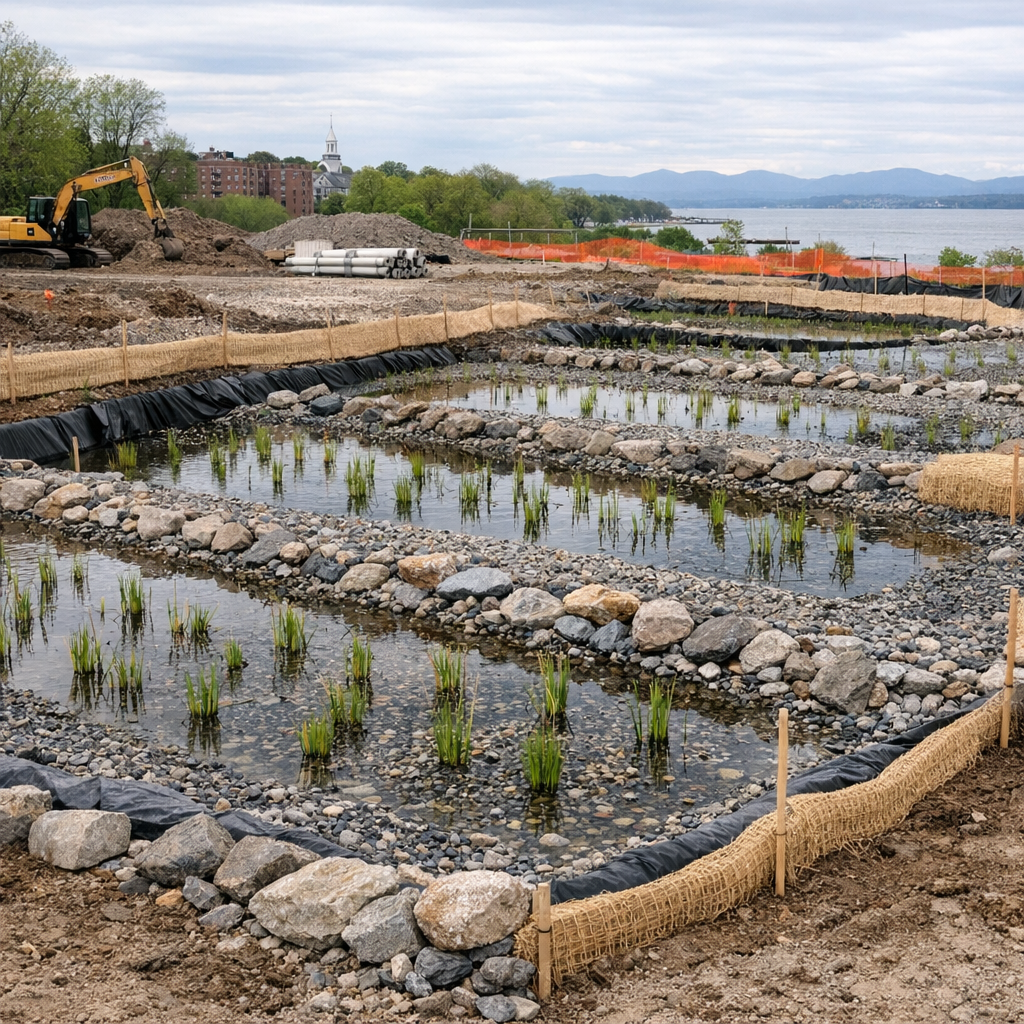
Burlington’s Lake Champlain watershed is seeing intensified stress: stormwater runoff carries pollutants such as phosphorus into the lake, fueling harmful algae blooms. To address this, Burlington teamed up with South Burlington and the University of Vermont for a major upgrade of a stormwater treatment site—the UVM Main Street Pond—which is being converted into a gravel wetland capable of removing thousands of grams of phosphorus annually before it enters waterways.
Another initiative, Operation Clean Sweep, helps prevent debris buildup in storm drains and roads—debris that would otherwise end up in Lake Champlain. These efforts are part of a broader strategy to update infrastructure and grow natural systems that improve both water clarity and lake health.
How You Can Help
- Keep storm drains clear of leaves, trash, and yard waste.
- Support or volunteer with local conservation groups focused on riparian habitat and wetland protection.
- Use landscaping practices that slow and filter runoff (like rain gardens or permeable surfaces).
- Stay informed via Vermont’s public health tracking tools, especially for air quality, blue-green algae alerts, and other hazards.
As climate change shapes our environment steadily rather than suddenly, it’s the cumulative steps we take—forests conserved, wetlands restored, pollution curbed—that will help Burlington remain resilient and vibrant for years to come.